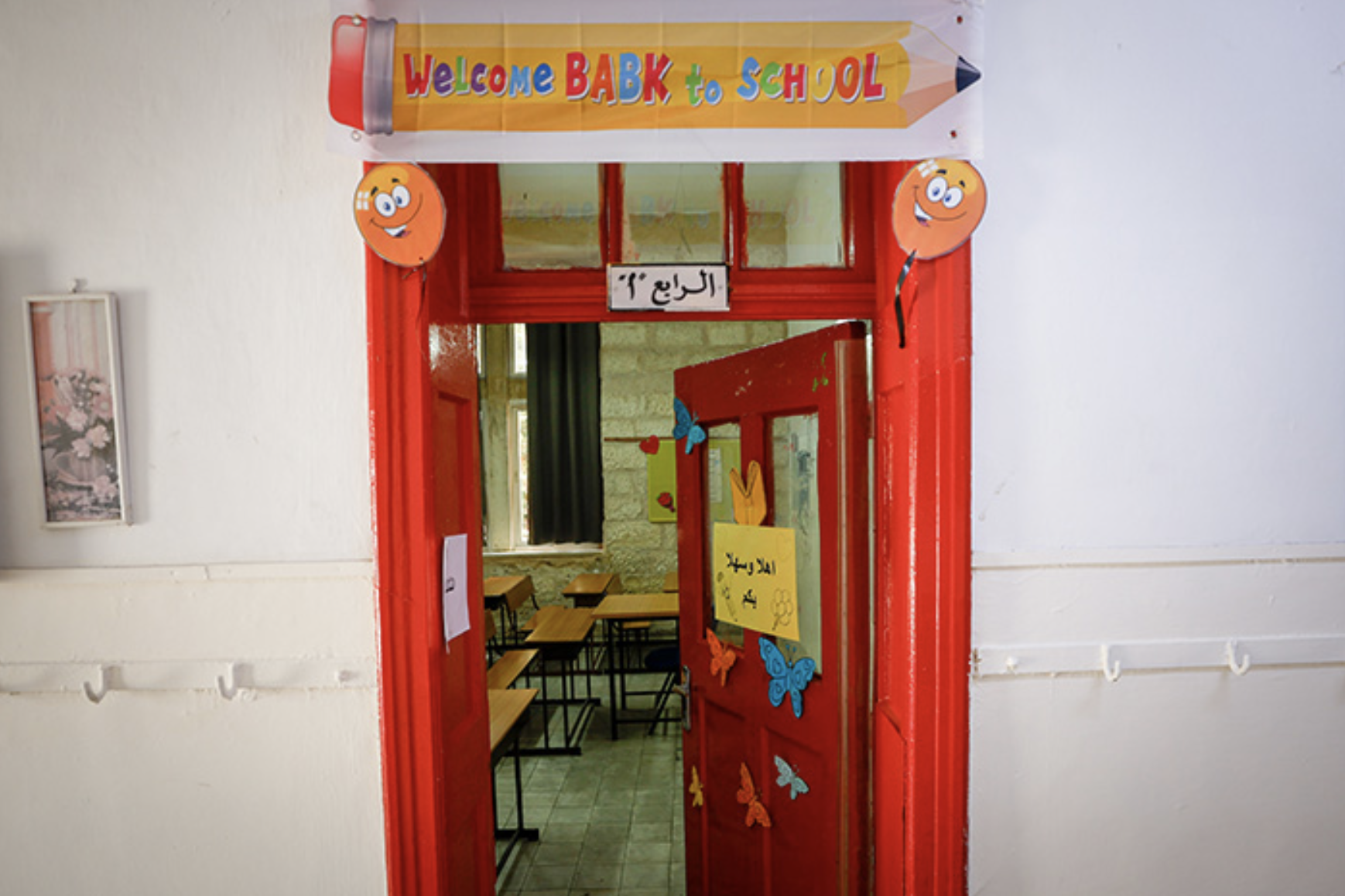
the first day of the new school year. September 1, 2026. © Jamal Awad/FLASH90
TerreSainte.net Editorial Staff — August 31, 2026
More than 70 teachers and staff members residing in the West Bank have not obtained the renewal of their permits to enter Israel. Unable to operate normally, Jerusalem’s Christian schools have cancelled the start of the school year. This new crisis directly threatens one of the key pillars of the Christian presence in the Holy Land.
The schoolbags were ready. The books had been covered, uniforms prepared, and classrooms put back in order. Yet on Tuesday, September 1, students at Jerusalem’s Christian schools did not return to school as planned.
On the eve of the new school year, more than 70 teachers and members of the educational, administrative and technical staff, all residents of the West Bank, had not received renewed permits to enter Israel. “This happened suddenly and without prior warning, preventing them from reaching their schools and directly affecting the schools’ preparations for the start of the school year,” stated a communiqué from the Jerusalem Christian Schools Office, published on August 31.
Unable to provide teaching, administrative and health services normally, as well as cleaning, maintenance, and security, the Christian schools announced that classes would be suspended from Tuesday, September 1, until the necessary permits are renewed. The decision was made after consultation with the relevant parties and representatives of the students’ parents.
The Terra Sancta Schools of the Custody of the Holy Land complied with this decision. In a brief message to families, their administration stated: “In accordance with the decision of the General Secretariat of the Christian Educational Institutions of Jerusalem, we inform you that classes will be suspended tomorrow, Tuesday, September 1, 2026. The date for resuming classes will be announced later.”
According to Hagop Djernazian, the Armenian Patriarchate has also reportedly issued a decree and decided that St. Tarkmanchatz School would join the action. “We stand together, united as one Church,” Djernazian commented.
This is not the first time this has happened. Last January, Jerusalem’s 12 Christian schools were forced to close after the permits of 171 teachers from the West Bank were cancelled. The second semester did not begin for the approximately 10,000 students attending these schools.
The schools eventually obtained authorization from the Israeli authorities allowing the teachers to continue working and complete the school year. They had hoped that these permits would be routinely renewed for the September school year. That did not happen.
Pressure to Change the Curriculum?
In this context, the repeated difficulties over teachers’ permits could perhaps be understood as an additional means of pressure to encourage Christian schools to abandon the Palestinian curriculum in favour of the Israeli curriculum. This interpretation should be treated with caution, but it reflects a real and growing trend. In its August 31 edition, the daily Haaretz reported that, beginning with this school year, all new first- and seventh-grade classes in East Jerusalem’s public schools will follow the Israeli curriculum. More than 45,000 Palestinian students out of approximately 120,000—38 percent—will therefore be studying under this curriculum, compared with fewer than 13,000 six years ago.
The newspaper notes that this development is the result both of growing demand from some parents and of pressure from the Israeli government, including financial incentives for schools willing to open classes preparing students for the bagrut examinations.
Parents who send their children to Christian schools are facing the same dilemma, as Terre Sainte Magazine explained in its March–April 2026 feature on education. They must choose between preserving a Palestinian education, culture and history, and obtaining a diploma that makes it easier to gain access to Israeli universities and the Israeli labour market. Of the 12 Christian schools in East Jerusalem, only two offered a bagrut track at that time.
Much More Than Schools
For the Churches of the Holy Land, this new crisis is not simply an administrative problem. It strikes at the very heart of their presence and mission.
Christian schools welcome both Christian and Muslim students. They do more than provide an education: they teach young people how to live together, respect one another, engage in dialogue, and accept others. In its recent message for the start of the school year, the Latin Patriarchate described them as a cornerstone of the Christian presence in the Holy Land and recalled that their service is an act of hope for the future of this land.
In his pastoral letter, Cardinal Pierbattista Pizzaballa went even further: “Our schools are perhaps the most beautiful gift that the Church offers to this land. They always have been. Generations of leaders, professionals, and men and women of goodwill—Christians, Muslims and Jews—have attended our schools. And this is not a minor detail: it is a mission.”
The Latin Patriarch of Jerusalem was referring specifically to the difficulties faced by teachers from the West Bank: “Recently, in Jerusalem, the problem of permits for teachers coming from Bethlehem arose, seriously jeopardizing our ability to preserve the Christian identity of our schools. Here too, the political conflict has direct consequences for the life of the Church.”
Denying teachers permits does more than prevent professionals from reaching their workplaces. It weakens a Christian institution, disrupts the lives of thousands of children and families, and places at risk an educational model that continues, against all odds, to prepare young people for peace.
“Our schools carry a message of peace, respect, understanding and acceptance of the other,” Sister Lucy Jadallah stressed in January. “We hope that this message will be received in the same spirit and with the same values on the other side.”
Eight months later, the school doors remain closed. And once again, hope is suspended, waiting for the permits to be issued.